Healthcare providers often assume Google Ads policy enforcement is clear, consistent, and predictable.
It is not.
Over the years, we have seen clinics lose weeks of visibility, pause campaigns unnecessarily, or spend money in the wrong places – all because of common myths about Google Ads policy.
Here are the ones that cause the most damage.
Myth #1 – Google says certification is required
Google Ads policy language frequently suggests that certain healthcare advertisers must obtain third-party certifications such as LegitScript.
In practice, approval paths vary.
- Some advertisers are approved through Google’s healthcare-related advertising certification alone.
- Some are denied by LegitScript but approved by Google Ads.
- Some are told they are “not eligible” for certification but are still prevented from running ads.
Policy text does not equal enforcement behaviour.
Myth #2 – Support can tell you exactly what is wrong
Healthcare advertisers often expect Google Ads Support to diagnose issues precisely.
What they usually receive:
- Repeated canned responses
- Policy citations without context
- No explanation of what triggered the review
- No confirmation of what resolved it
In some cases, ads resume without any changes at all.
That does not mean the issue was fixed. It means enforcement moved on.
Myth #3 – Paying for LegitScript guarantees your ads will run
This is one of the most expensive misunderstandings in healthcare advertising.
- LegitScript does not guarantee approval.
- It does not prevent future shutdowns.
- It does not override Google’s internal classification of your services.
It is a tool – not a shield.
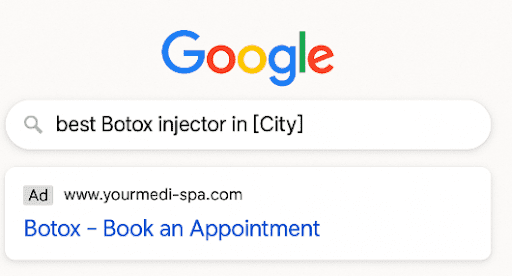
We had a Botox client apply for LegitScript and be denied. Thankfully they were approved for Google Healthcare Advertising.
Myth #4 – If competitors are running ads, you are allowed to
Competitors may be:
- Running legacy accounts not yet re-reviewed
- Flying under enforcement thresholds
- One account change away from suspension
Google Ads policy enforcement is not retroactive or uniform and visibility today does not promise the same for tomorrow.
Myth #5 – Policy issues are separate from account optimization
In healthcare, optimization can trigger enforcement.
Common risk points include:
- Expanding keyword themes
- Updating ads
- Modifying campaign bidding options
This is why “we optimized the account and it got shut down again” is not rare.
The real issue clinics miss
Most healthcare advertisers focus on:
But policy risk lives in:
- Account structure
- Service categorization
- Landing page intent
- Measurement alignment
Without understanding that layer, Google Ads becomes unstable – even when performance looks strong.
When ads stop running, clinics often assume:
- Google Ads does not work for healthcare
- Marketing failed
- Demand dropped
In reality, many are victims of misinterpreted policy combined with weak tracking and reactive fixes.
What to do instead
Healthcare Google Ads requires:
- Proactive policy-aware account design
- Measurement tied to real patient outcomes
- Decisions based on how Google behaves, not just what policy text says
👉 Learn more about Marketing for Healthcare Providers